'/%3E%3C/svg%3E)



In the rapidly evolving world of technology, new definitions and terminology is a constant as technical advancements shift what’s possible. The industry conversation has shifted from largely cloud-based AI and the industrial IoT (IIoT) to embedded intelligence and edge AI. The latest term to grab headlines and demand our attention is physical AI.
But this is not just a redefinition, or another layer of marketing polish. The shift from edge AI to physical AI actually signals a fundamental change. It is a shift not in what AI is, but in what AI does. As systems move from simply interpreting the world to actively interacting with it, the implications for semiconductor design are significant.
From Edge AI to Physical AI
While industrial IoT was primarily about connectivity, gathering data from sensors for retrospective analysis, edge AI moved the ‘thinking’ closer to the source to save bandwidth and reduce latency. Physical AI builds on both of these but with a critical extra dimension: it closes the loop between perception and action.
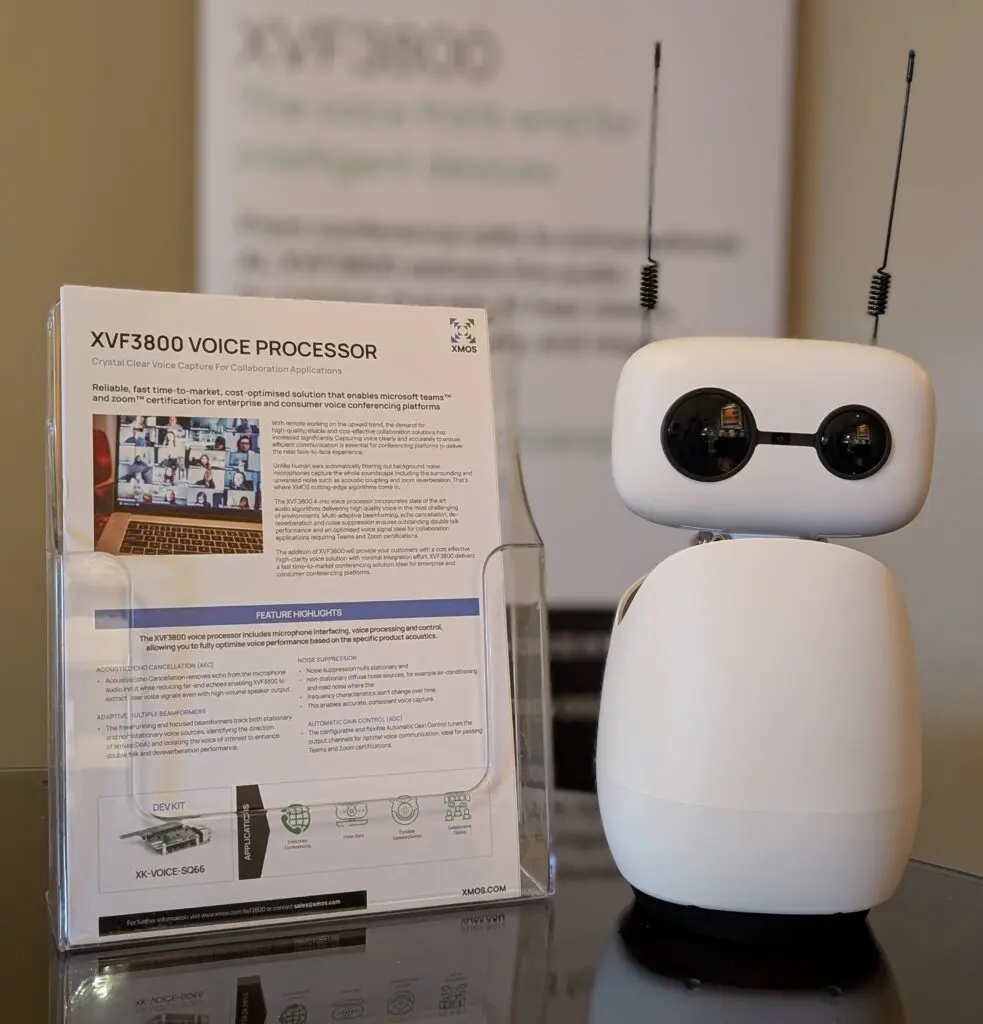
This is a key distinction. Whether it’s a robotic arm, an autonomous drone, or a haptic interface, physical AI is dealing with a body. Where an edge AI system needs to recognise a voice command, classify an image, or process a change in data, a physical AI system is required to act on that information instantly.
This difference is not just technical, it’s consequential.
The Real-Time Mandate: Action Over Inference
A 100ms lag in a chatbot is, at best, barely noticeable and, at worst, a minor inconvenience. A 100ms delay in a control loop is a mechanical failure, with potentially catastrophic consequences.
This is why physical AI isn’t a fundamental shift in algorithms, but it is a fundamental shift in system requirements. Traditional processor architectures are typically optimised for throughput, but physical AI operates in environments where timing is everything; where worst-case performance matters more than peak or average-case performance. This shifts the design priority toward determinism.
Deterministic execution ensures that tasks, whether they are neural network inferences or motor control adjustments, complete within known, predictable time bounds, regardless of the system load.
Parallelism as a First Principle
Physical AI workloads are inherently multi-modal and parallel. For example, a single device might be simultaneously managing multiple sensor inputs (such as audio, vision, or light detection), continuous data processing, real-time decision making, and immediate actuation.
Architectures that rely on ‘best-effort’ time-slicing struggle with this balance. To meet the demands of physical AI, silicon needs true hardware parallelism. This allows critical I/O and control tasks to run independently of the AI workload, ensuring that a spike in ‘thinking’ never starves the ‘doing’ of resources.
Silicon That Does
Physical AI is an evolution of edge AI and embedded systems that introduces a crucial requirement: systems that perceive, decide and act in real time.
For XMOS, this real-time expectation reinforces the value of our XCORE® architecture. By building silicon designed for determinism and parallelism from the ground up, we bridge the gap between software-defined intelligence and hardware-defined action.
Physical AI is a decisive step forwards toward a world where machines don’t just process data, they are active participants in their environment. As this shift occurs, it is no longer sufficient for silicon to be fast or powerful, it must be on time every time.
Explore how XMOS deterministic silicon is enabling real-time physical AI systems—read our CES 2026 roundup featuring Reachy Mini.