'/%3E%3C/svg%3E)



In the engineering of high-performance gaming systems, latency is often treated as a number to be minimised. Marketing materials celebrate lower milliseconds; benchmarks compare input lag and audio delay; firmware teams chase faster loops and higher polling rates. But this framing, while convenient, misses something fundamental.
Latency is not just a scalar metric. It is a temporal behaviour of a system.
What ultimately shapes user experience is not simply how fast a system responds, but how predictably it does so. A system that responds in 10 milliseconds most of the time, but occasionally in 20, feels worse than one that consistently responds in 15. The human perceptual system is remarkably tolerant of delay—but deeply intolerant of inconsistency.
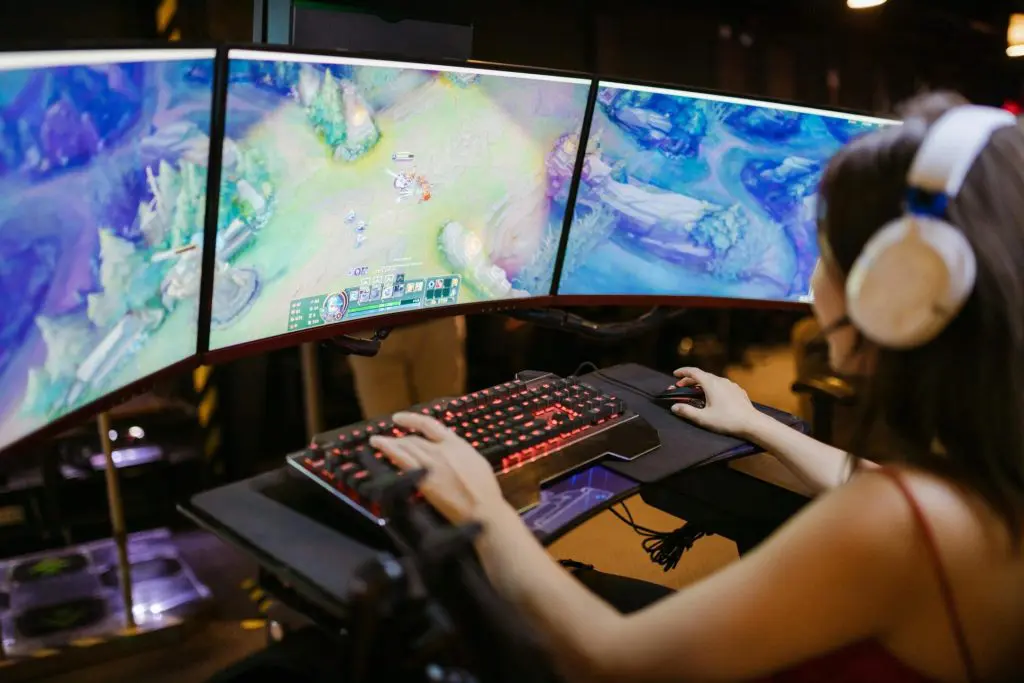
This becomes especially apparent when you look across three seemingly different domains in gaming: spatial audio rendering, input device polling, and AI-driven voice pipelines. Each operates on different data, different timescales, and different algorithms. Yet all are governed by the same constraint: timing stability.
Spatial Audio: When Phase Stops Being Stable
Consider HRTF-based spatial audio, where the goal is to convincingly place sounds in three-dimensional space using headphones. The underlying mechanism is well understood: replicate the way sound interacts with the human body by applying filters that encode interaural time differences (ITD), interaural level differences (ILD), and frequency-dependent phase shifts.
At a conceptual level, spatial audio depends on maintaining a precise relationship between the signals reaching the left and right ears. These relationships exist on the scale of microseconds. The brain uses them to infer direction, distance, and even elevation.
If you were to sketch this, you might draw two waveforms—left and right channels—slightly offset in time and amplitude. That offset is the cue. It must be stable.
Now introduce a real system. Audio is processed in buffers, scheduled on threads, and passed through multiple stages of DSP. Even if each stage is individually correct, small variations in when buffers are processed begin to creep in. A frame arrives slightly earlier, the next slightly later. Over time, the phase relationship between channels is not fixed—it wobbles.
This is where latency stops being about delay and starts being about coherence. A constant 15 ms delay across both channels preserves the spatial illusion. A variable delay—even if it averages lower—does not. The inter-channel phase coherence required during playback is disrupted by buffer timing variability, and the brain notices.
The result is rarely dramatic. Instead of a sound snapping cleanly into position, it feels slightly unstable. Footsteps don’t quite lock to a direction. A sound source seems to drift or “swim.” Front-back discrimination becomes less reliable. Users may not describe this as a latency issue at all; they may blame the HRTF model, or the headphone quality. But the root cause is often timing instability.
In spatial audio, then, the requirement is not just low latency—it is phase-consistent latency. The system must behave as if every audio frame is delivered on a metronome.
Input Systems: The Illusion of Responsiveness
Shift focus to input devices, and the narrative appears different at first. Here, latency is measured in polling intervals: 8 ms at 125 Hz, 1 ms at 1000 Hz, down to fractions of a millisecond at the highest-end devices. The industry has largely converged on the idea that higher polling rates equate to better responsiveness.
But polling rate is only half the story.
What matters just as much is whether those intervals are uniform. If a device nominally reports every millisecond but actually delivers samples at 0.7 ms, then 1.4 ms, then 0.9 ms, the system receiving that input sees a non-uniform time series. And just like in audio, irregular sampling introduces artefacts.
Imagine plotting mouse position over time. In a perfectly regular system, the samples form a smooth, evenly spaced sequence. In a jittery system, the spacing varies. When the game engine consumes this data—often synchronised to its own frame loop—it must interpolate or integrate across uneven intervals. The result is subtle but perceptible: motion feels inconsistent.
Players describe this in qualitative terms. The controls feel “loose,” or “floaty,” or lacking in “tightness.” In competitive settings, this becomes critical. Muscle memory depends on consistent mapping between physical movement and on-screen response. If the timing varies, that mapping degrades.
Interestingly, a slightly slower but more consistent system can feel better than a faster but jittery one. A 2 ms fixed interval provides a stable basis for prediction and control. A 1 ms average with ±0.5 ms variation does not.
Under the hood, this variability is rarely attributable to a single source. It emerges from the interaction of multiple layers: device firmware, USB host scheduling, operating system interrupt handling, and the game engine’s own sampling loop. Each layer introduces small uncertainties. Together, they form a composite jitter profile that the user ultimately experiences.
Again, the pattern is the same as in spatial audio. The system is not failing because it is slow. It is failing because it is inconsistent.
Voice Pipelines: Timing as Conversation
The third domain—AI microphone pipelines and voice activity detection—introduces a different kind of sensitivity. Here, the system is not just processing signals; it is participating in a form of interaction that humans are evolutionarily tuned to.
Conversation is governed by timing. Turn-taking gaps are typically on the order of a few hundred milliseconds. Delays beyond that begin to feel unnatural. But more importantly, variability in those delays disrupts the rhythm of interaction.
Voice activity detection (VAD) sits at the front of this pipeline. It decides when speech begins and ends, triggering downstream processing. To do this, it operates on buffered audio frames, often in windows of 10 to 30 milliseconds, applying feature extraction and inference models.
Each of these steps introduces latency. But as before, the average delay is only part of the story.
If the system consistently detects speech onset 120 ms after it begins, users adapt. But if detection sometimes occurs at 80 ms and other times at 180 ms, the experience becomes unpredictable. Early phonemes may be clipped in some cases and preserved in others. Responses may feel snappy one moment and sluggish the next.
In team-based gaming, this inconsistency has tangible effects. Players talk over each other, or hesitate waiting for confirmation that they’ve been heard. In AI-driven interactions, commands may appear unreliable—not because recognition is wrong, but because timing is erratic.
The underlying causes are familiar: buffering strategies, variable inference times, thread scheduling, and adaptive algorithms that change behaviour based on noise conditions. Each introduces a degree of temporal uncertainty.
There is also an inherent tension between accuracy and latency. Larger analysis windows improve robustness but increase delay. Smaller windows reduce delay but risk false positives. Yet even within a chosen trade-off, the requirement remains the same: execution must be predictable.
In voice systems, as in audio and input, consistency defines quality.
One Constraint, Three Systems
What emerges from these three domains is not just a set of similar problems, but a shared underlying constraint.
In spatial audio, timing instability corrupts phase relationships.
In input systems, it disrupts motion continuity.
In voice pipelines, it breaks conversational rhythm.
In each case, the system may meet its average latency targets. And in each case, that is not enough.
The unifying requirement is bounded, predictable low-latency operation, a system that behaves the same way, every time, within tight temporal bounds.
This has important implications for how systems are designed. Latency can no longer be treated as a byproduct of individual components. It must be considered end-to-end, across the entire pipeline. Scheduling, buffering, clocking, and workload design all contribute to the final temporal behaviour.
Achieving this often requires trade-offs. Ensuring predictable execution may mean reserving compute resources, or simplifying adaptive algorithms. It may require tighter integration between hardware and software, or the use of real-time scheduling techniques that are more complex to implement.
In some designs, the most reliable path to bounded latency is to remove timing-critical processing from the host CPU entirely. Rather than asking a general-purpose operating system to deliver real-time guarantees it was not designed to provide, alternative architectures offload the time-sensitive work to silicon that can.
One architecture that addresses this directly is the XCORE® processor. Its defining characteristic is deterministic, cycle-accurate execution: every instruction completes in a known number of cycles, with no cache misses, no speculative execution, and no OS scheduler to introduce variance. Multiple hardware threads share a single core, each guaranteed a fixed time slice — making the device well-suited to running spatial audio pipelines, input polling loops, and VAD front-ends concurrently, with timing behaviour that is predictable by construction rather than by tuning. This is a well-established pattern in professional audio interfaces and is increasingly relevant in gaming peripherals and voice front-end design, where the cost of a small, dedicated processor is justified by the consistency it delivers.
The payoff is disproportionate – when timing is stable, systems feel coherent. Audio locks into place. Controls feel precise. Voice interactions become natural.
Timing Is What Users Perceive
A useful way to think about this is through the lens of music. A performance can be slightly faster or slower than the original tempo and still sound good—provided all musicians stay in time with each other. But if each musician drifts independently, the result is immediately jarring.
Gaming systems are, in effect, ensembles of real-time processes. Spatial audio, input handling, and AI pipelines are all playing their part. What matters is not just how fast each one operates, but how well they stay in sync.
This is why the pursuit of ever-lower latency, while valuable, is incomplete. The real goal is temporal discipline. Systems must not only be fast—they must be reliably fast.
Because in the end, users do not perceive milliseconds. They perceive stability, coherence, and control. And those emerge not from minimum latency, but from consistent latency.
References and Further Reading
Blauert, J. (1996). Spatial Hearing: The Psychophysics of Human Sound Localization. MIT Press. Foundational reference on ITD, ILD, and HRTF-based spatial perception.
Casiez, G., Vogel, D., Balakrishnan, R., & Cockburn, A. (2008). The Impact of Control-Display Gain on User Performance in Pointing Tasks. Human-Computer Interaction, pages 215–250. Empirical study of how input response consistency affects perceived responsiveness and pointing performance.
Levinson, S. C. (2015). Turn-taking in human communication—Origins and implications for language processing. Trends in Cognitive Sciences, 20(1), 6–14. Cross-linguistic analysis establishing ~200 ms as the median turn-transition interval in conversation.
Wimmer, Schmid & Bockes (2019) — “On the Latency of USB-Connected Input Devices” — CHI 2019. Directly relevant to input jitter.
Wessel & Wright (2002) — “Problems and Prospects for Intimate Musical Control of Computers” — Computer Music Journal. Covers audio latency perception in real-time systems.