
Truly immersive audio relies on capturing more than the sound itself. It also needs to preserve where that sound has come from, and how it interacts with the space around it. For filmmakers, sound designers, recording engineers and VR/AR creators, that spatial detail is critical for bringing an audio experience to life.
Higher-order Ambisonics (HOA) captures a three-dimensional soundfield, allowing recordings to be adapted for different playback formats in post-production. Combining this technology with a large microphone array and real-time multicore processing brings sophisticated spatial audio capture into a single, practical recording device.
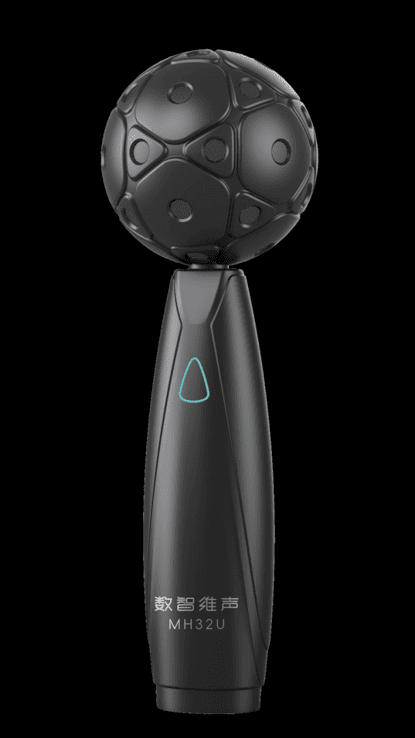
That is the approach behind the “数智维声®” MH32U, a professional 32-channel spherical microphone developed by Radio Film & Television Digital Intelligence (Beijing) Technology Co., Ltd. Powered by the XCORE processor, it brings synchronised multichannel capture into a compact system for film, music, live performance, broadcasting and immersive experiences.
Capturing the detail of a three-dimensional soundfield
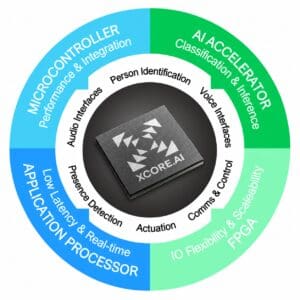
The XCORE multicore processor combines DSP, AI, MCU and programmable I/O capabilities on a single chip. Its deterministic, real-time parallel processing architecture supports a wide range of audio products, including two- and four-microphone arrays for voice capture, sound-source localisation, noise cancellation and beamforming.
Professional spatial recording places different demands on a microphone array. Capturing fine detail about a sound’s direction, elevation and the surrounding acoustic environment calls for more microphones, all working in perfect synchronisation.
The MH32U addresses this with 32 microphone capsules arranged in a single spherical array, providing a cost-effective solution for professional spatial audio capture.
“Conventional recording equipment often captures the sound without preserving all the information about its direction, distance and the acoustics of the space,” explains Xu Zifan, R&D Lead in the company’s Product Division. “That sense of space then has to be recreated manually in post-production, which takes time and can limit how faithfully the original soundfield is reproduced.
“Keeping multiple channels synchronised while processing audio with low latency is particularly challenging in complex recording environments. During live performances or recordings in large spaces, differences between channel clocks can compromise the spatial effect. Noise, echo and reverberation make it harder still to capture distant sounds while retaining their spatial detail.”
Meeting the demands of 32-channel recording
Scaling a microphone array to 32 channels introduces several engineering challenges. In the MH32U, sampling timing errors between microphones must remain below 100 ns. At the same time, the system needs to balance channel gain and stream high-bandwidth audio continuously.
Systems that rely on RTOS-based software scheduling can introduce timing jitter, making strict synchronisation harder to achieve. Designs with tightly coupled hardware and software can also be difficult to update once in production, limiting the scope for improving audio algorithms over a product’s lifetime.
XCORE addresses these challenges through a hardware-event-driven multicore architecture that operates without an operating system. Multiple cores handle tasks independently and in parallel, delivering deterministic responses without the timing jitter associated with pre-emptive software scheduling.
Four capabilities are central to the design:
- Precise microphone synchronisation. Hardware timestamps provide a common sampling reference across the array, while XCORE processes multiple PDM audio streams in parallel. This keeps timing errors within specification and helps preserve the integrity of the captured soundfield.
- Consistent levels across channels. Firmware adjusts each microphone’s gain independently to compensate for variations in MEMS microphone sensitivity. The resulting raw audio has balanced channel levels, reducing the need for correction in post-production and improving consistency between devices.
- High-bandwidth audio output. XCORE supports USB 2.0, PDM and I2S connectivity, with no need for an external USB bridge chip. This simplifies the bill of materials and supports reliable multichannel audio streaming.
- Flexibility throughout the product lifecycle. Programmable I/O and software-defined processing allow manufacturers to improve audio algorithms through firmware updates after launch. The same architecture and toolchain can support products ranging from small voice arrays to professional 32-channel recording systems.
Inside the MH32U
The MH32U brings 32 microphone capsules together in one spherical array, capturing sound from all directions alongside the spatial detail needed for higher-order Ambisonics recording. Integrating the array into a single device reduces the cabling and setup associated with systems built from multiple separate microphones.
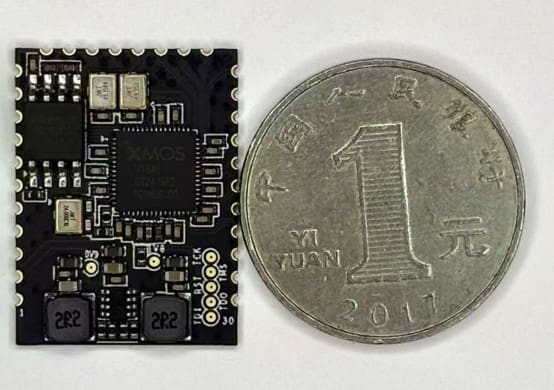
During development, the company evaluated several processor platforms. The challenge was to find one that could combine precise 32-channel synchronisation, channel gain balancing, high-speed USB output and firmware updates. Multichip designs added further constraints around size, power consumption and heat.
XCORE met these requirements while offering an established audio development ecosystem and extensive experience in microphone-array applications.
“Our expertise spans spatial audio algorithms, microphone-array design and bringing finished products to market,” says Xu Li, Head of the company’s Product Division. “Working with XMOS allows us to combine those capabilities with XCORE’s processing power and architectural advantages.
“We also draw on practical experience in broadcasting, cultural attractions and live performance. That means we can support customers with application-specific tuning and tailored algorithm updates, as well as the hardware itself.”
Inside the microphone, XCORE handles three key stages of signal preprocessing:
- Synchronisation: Multiple cores process all 32 PDM audio streams in parallel, using hardware timestamps to align sampling and keep timing errors below 100ns.
- Gain balancing: Firmware adjusts each microphone’s gain to compensate for sensitivity differences, producing balanced raw A-format audio.
- USB streaming: Integrated USB 2.0 hardware sends all 32 channels of 24-bit, 48 kHz audio to a digital audio workstation (DAW).
On the workstation, a VST encoder plug-in converts the incoming audio into fourth-order HOA B-format. The recording can then be decoded into formats such as 5.1.4, 7.1.4 or binaural audio, giving production teams flexibility over the final listening experience.
The MH32U delivers a frequency response of 30 Hz–20 kHz and a dynamic range of 104 dB. Factory acoustic calibration, combined with XCORE’s synchronisation and gain balancing, helps maintain consistent performance across production units and reduces the corrective work needed in post-production.
Giving audio developers more room to innovate
By handling synchronisation, channel balancing and high-speed streaming at the silicon and firmware level, XCORE reduces the underlying engineering work involved in developing a microphone-array product. Teams can devote more time to acoustic design, audio algorithms and the finished user experience.
The benefits extend across different types of audio equipment. In the consumer and developer market, Seeed Studio’s ReSpeaker, powered by the XMOS XVF3800 demonstrates how XCORE supports compact microphone arrays for voice applications. Its parallel processing capabilities provide the foundation for synchronisation and audio processing, supporting features such as beamforming, sound-source localisation, echo cancellation and far-field voice capture.
XCORE Voice solutions are widely used for voice prototyping, conferencing and AI enabled voice processing. The MH32U applies the same underlying XCORE architecture to the demands of professional spatial audio recording.
“Working on the MH32U brings together XCORE’s real-time processing capabilities and the company’s deep expertise in spatial audio,” says Tao Mu, Sales Director for XMOS Asia Pacific. “The team has contributed to standards frameworks and technical specifications, as well as research and standards development for 3D audio capture in broadcasting and online media.
“That experience gives the team a strong understanding of what production teams need from their equipment. XCORE helps connect capture, production and playback in a practical workflow, making it easier for customers to create immersive audio content. It also supports more portable recording systems that reduce the cabling and setup involved in location work.”
XCORE’s programmable I/O allows manufacturers to continue refining their products through firmware updates. Alongside its scalability, this gives developers a platform they can use across consumer voice devices, conferencing products and professional recording equipment.
For the MH32U, the result is a 32-channel spatial audio system that combines precise timing, balanced capture and reliable streaming in a single microphone array—making sophisticated immersive recording more practical on location and in the studio.