

A person calls for help from across the room. The television is on, they are facing away from their care hub, and their voice is quieter than usual.
For a telecare device, this is exactly the kind of situation it needs to handle. People cannot always move closer, speak louder or turn down the background noise before asking for support.
Reliable voice communication is fundamental to technology-enabled care. It connects the person who needs help with someone who can understand their situation and respond. For manufacturers developing telecare hubs, that means designing for the acoustic challenges of real homes from the outset.
Being heard from across the room
A care hub may sit on a shelf or hallway table while its user is several metres away. Someone with limited mobility, or who has fallen, may be unable to approach it. They may also be speaking towards the floor or away from the microphones.
Far-field voice pickup helps capture speech at a distance. Combined with microphone beamforming, which focuses on speech arriving from a particular direction, it helps make the user’s voice clearer amid surrounding sounds.
The aim is straightforward: people should be able to communicate from where they are, without having to position themselves carefully in front of a device.

Keeping speech clear in everyday noise
Homes contain competing sounds, from extractor fans and washing machines to televisions and visiting family members. Hard surfaces also reflect sound, creating reverberation that can make words harder to distinguish.
Simply increasing microphone sensitivity captures more of everything, including unwanted noise.
Noise suppression reduces competing background sound while preserving speech. Dereverberation reduces the effect of room reflections, helping make the captured voice more intelligible. Automatic gain control helps maintain a consistent speech level as speaking volume and distance change.
Together, these capabilities help the person answering a call understand what is being said with less effort and fewer requests for repetition. That matters particularly when the caller is distressed or struggling to speak.
Making two-way conversation feel natural
Clear care communication depends on both people being able to speak and listen comfortably.
During a call, the hub’s microphones pick up sound from its own loudspeaker as well as the user’s voice. Without effective acoustic echo cancellation, that loudspeaker output can return to the remote listener as an echo. Acoustic echo cancellation reduces this feedback, helping keep the conversation clear. Equally important is how the system behaves when both people speak at once, known as double-talk. A user may need to interrupt an operator to explain that they are in pain or correct a misunderstanding. Robust full-duplex audio allows both sides to speak simultaneously, helping preserve the user’s words while the hub’s loudspeaker is active.
People should be able to speak naturally, including interrupting when they need to, without learning how to take turns with the technology.
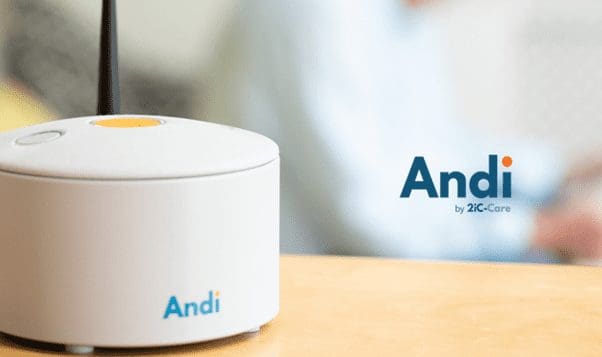
Reliable voice in practice: the Andi Hub
For UK care technology company 2iC-Care, reliable, high-quality two-way audio was a central requirement when developing its Andi Hub.
The company selected XMOS voice technology to support communication in challenging home environments. Its implementation combines far-field pickup and adaptive beamforming with acoustic echo cancellation, noise suppression and dereverberation. Double-talk robustness helps sustain natural conversation, including when a user speaks over the person at the other end.
XMOS also supported audio configuration, integration and optimisation, helping 2iC-Care achieve the voice performance its application required.
Designing around the person who needs care
Reliable voice performance requires the complete audio system to work together. Microphone placement, loudspeaker design and acoustic tuning all influence what the remote listener hears.
Testing should reflect how people will actually use the hub: speaking from different positions, facing away from it, talking quietly and interrupting while audio is playing. Background noise and room acoustics need to be part of that evaluation.
For the person receiving care, the technology should make communication feel simple. Being heard clearly, and being able to respond naturally, can provide reassurance at a difficult moment.
Delivering that experience starts with choosing a voice processing solution suited to the device and its environment.
Why XMOS for voice in telehealth?
XMOS voice processors combine dedicated digital signal processing with configurable audio pipelines, giving manufacturers control over how their care hub captures and processes speech. The four-microphone VocalFusion® XVF3800 supports 360-degree voice pickup and multiple beamformers to track speakers, alongside full-duplex acoustic echo cancellation, noise suppression and automatic gain control. Continuous double-talk support helps preserve conversation when the resident and care operator speak simultaneously. Alternatively, the one- or two-microphone XVF3620 combines adaptive beamforming with AI denoising and dereverberation. Both offer USB or I²S audio interfaces and runtime parameter control, allowing developers to integrate the voice processor with their host system and tune performance for the hub’s acoustic design.