
Apple’s latest home announcements put voice firmly in the spotlight. The new Apple TV 4K features three far-field microphones and advanced echo cancellation, enabling hands-free Siri interaction even while audio is playing. The new HomeView display also makes voice central to finding information, enjoying entertainment and controlling the home.
At XMOS, we see this as a powerful endorsement of a direction we have long believed in: voice as the gateway to seamless everyday experiences.
For product developers, it also highlights a fundamental requirement. Before a device can understand a request or act on it, it needs to hear the person making it.

Effortless interaction takes sophisticated engineering
Asking a television to find a programme or a kitchen display to set a timer feels simple. Delivering that experience reliably takes careful audio engineering.
People speak from different positions and distances. Rooms introduce reflections and reverberation. Appliances, conversations and traffic add background noise. Often, the device being addressed is itself playing music, dialogue or a spoken response.
A successful voice interface needs to capture the user’s speech through all of this. Otherwise, the experience quickly becomes one of repetition, raised voices and frustration.
Far-field capture, acoustic echo cancellation, beamforming and noise reduction help address these challenges. Echo cancellation reduces the device’s own playback in the microphone signal. Beamforming uses multiple microphones to focus capture towards the person speaking, while noise reduction helps reduce unwanted background sound.
Together, these capabilities provide a clearer speech signal for the recognition system that follows. More capable voice assistants make that foundation increasingly important.
Established expertise for the next generation of voice products
These are challenges XMOS has been helping developers solve for years.
Our VocalFusion® voice processors combine microphone processing with an integrated audio pipeline, giving product teams a practical route to clear voice capture.
The four-microphone XVF3800 brings together acoustic echo cancellation, multi-beamforming, dereverberation, noise suppression and automatic gain control for far-field voice applications. Its echo cancellation enables voice capture even with high-volume speaker output.
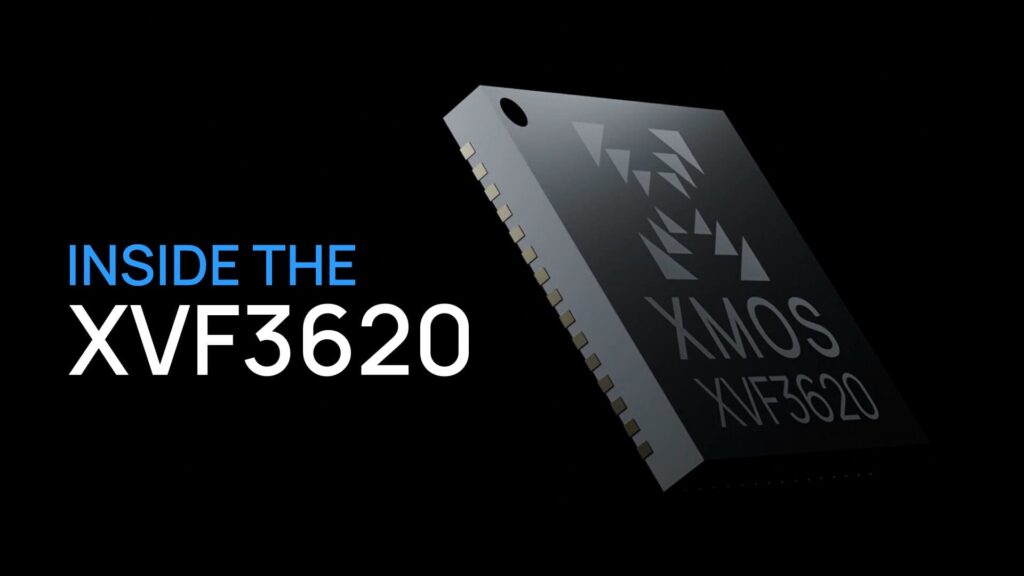
The XVF3620 adds AI-based noise reduction to a complete on-chip voice processing pipeline, supporting one or two microphones. Designed for noisy, reverberant and changing environments, it combines noise reduction with fast-adapting echo cancellation and two-microphone beamforming.
For developers building on XCORE.AI, the XCORE®-VOICE framework provides a software route to voice interfaces, with support for integrating capabilities such as keyword recognition and local voice commands.
These options help product teams choose an approach that fits their application, whether they are developing a TV, smart display, conferencing system or home appliance.
Design for the room where the product will live
The right voice solution starts with the intended experience.
How far away will people speak? Will the product play audio while listening? What background noise will it encounter? How many microphones can the design accommodate?
A display used in a busy kitchen faces different acoustic conditions from a conferencing system or an outdoor intercom. Microphone placement, enclosure design and the processing pipeline all need to work together, with evaluation in conditions that reflect everyday use.
Planning for these requirements early helps developers make voice a dependable part of the product.
Bringing natural voice interaction to more devices
Apple’s announcements reinforce the importance of voice in the connected home. For the wider industry, they underline the opportunity to make everyday products easier and more natural to use.
XMOS gives developers the voice-processing foundation to pursue that opportunity, helping devices hear clearly so people can interact with confidence.